
There’s a question every franchisor should ask before committing another dollar to franchise development marketing: Are all the people responsible for our growth actually working toward the same goal?
It sounds simple. But in my experience working with franchise brands, alignment is one of the easiest things to assume and one of the hardest things to maintain. Marketing teams focus on generating interest. Franchise development teams focus on converting candidates. Leadership focuses on signed agreements and system growth. Agency partners focus on executing programs and demonstrating performance.
Everyone may be doing their job well. But that doesn’t necessarily mean everyone is working together effectively.
And when franchise development budgets are limited and growth expectations remain high, the cost of that disconnect can be significant.
Growth Goals Are Shared. Accountability Isn’t Always.
Recent franchise development benchmarks presented at the Franchise Leadership & Development Conference illustrate just how interconnected the development process really is.
According to the research, the average annual franchise development marketing investment was $297,000, while the median was $200,000. The same benchmarks reported an overall lead-to-sale conversion rate of 2.2%.
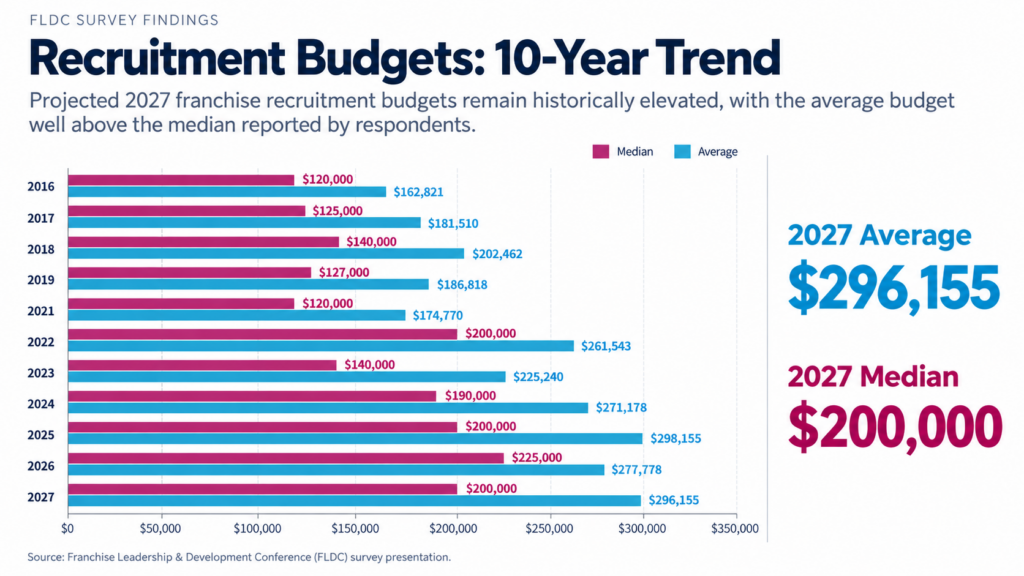
FLDC survey data compares average and median franchise recruitment marketing budgets over the past decade. For 2027, respondents project an average budget of $296,155 versus a median of $200,000, highlighting the importance of interpreting industry spending benchmarks in context.
Source: Franchise Leadership & Development Conference (FLDC).
Consider what those numbers mean for a franchise brand targeting 25 new agreements annually. At a 2.2% conversion rate, that goal would require approximately 1,137 initial inquiries. Using additional reported conversion benchmarks, an illustrative development model suggests a need for approximately 250 qualified leads, 93 applications, and 39 Discovery Day attendees to achieve those 25 agreements.
Those figures aren’t a blueprint for every franchise system. They’re survey-derived averages applied to a hypothetical growth scenario. An established franchisor with strong brand recognition and an experienced sales team will face different circumstances than an emerging concept still establishing market awareness. But the underlying lesson applies to both: Generating an inquiry is only the beginning of a much longer process.
If an agency successfully generates interest but the development team struggles to move candidates forward, is the marketing program underperforming? If sales reports that lead quality is poor but marketing has no visibility into what happens after an inquiry, how can targeting improve?
These aren’t simply marketing questions or sales questions. They’re questions about organizational alignment.
The Most Expensive Problems Often Happen Between Teams
One of the greatest challenges in franchise development is that success depends on multiple teams influencing the same outcome, often with different information and priorities.
Consider a common scenario: A franchise brand launches a campaign intended to attract candidates in several target markets. The agency measures performance based on inquiries and cost per lead. The franchise development team evaluates candidates based on available capital, operational experience, and geographic fit. Marketing sees an efficient campaign. Development sees a pipeline filled with candidates who aren’t financially qualified or aren’t interested in the right markets. Sound familiar?
Both teams may be accurately reporting what they see. Neither has the complete picture because the problem is that neither team is looking at the entire funnel. The disconnect becomes especially costly when it continues for months without meaningful adjustments. That’s why effective client-agency relationships have to extend beyond campaign updates and monthly performance reports. They require ongoing conversations about candidate quality, sales feedback, market priorities, and the obstacles affecting conversion.
The goal shouldn’t be to determine which team is responsible for an underperforming metric. It should be to identify what needs to change to improve the business outcome.
Alignment Starts With Defining Success the Same Way
Ask five stakeholders what constitutes a successful franchise development campaign, and you may get five different answers.
For an advertising team, it might be lower cost per lead. For a PR team, it might be increased brand visibility and third-party credibility. For franchise development, it might be more financially qualified candidates. For executive leadership, it’s likely to be signed agreements that support the company’s expansion objectives.
These priorities aren’t inherently in conflict. In fact, each can contribute to a successful development program. But they need to connect to a shared definition of success. That means establishing expectations before campaigns launch, including what constitutes a qualified candidate, which geographic markets matter most, how quickly inquiries should receive follow-up, and what information needs to flow between marketing and development.
It also means making performance data accessible across teams. If an advertising campaign produces 100 inquiries, that’s useful information. Knowing how many were qualified, how many entered serious conversations, and where candidates disengaged is far more valuable.
When agency partners understand the entire candidate journey, they can make better recommendations. When franchise development teams understand the strategies driving inquiries, they can provide more actionable feedback. And when leadership sees how those activities connect, it becomes easier to make informed investment decisions.
Different Budgets Require Different Conversations
The research also underscores a reality that franchise marketers understand well: Not every brand has the same resources.
The reported $97,000 difference between average and median annual marketing spending is a reminder that industry benchmarks don’t necessarily represent what an individual franchise system can or should invest. Some franchisors are preparing for aggressive expansion. Others are focused on entering a handful of priority markets. Some have sophisticated internal sales operations, while others rely on lean teams managing multiple responsibilities.
Those differences should shape how agencies and clients work together. A brand with substantial marketing resources may be able to support multiple lead generation channels, a comprehensive communications program, and ongoing audience testing. A smaller system may need to concentrate its spending in a few priority areas while relying more heavily on existing relationships, organic visibility, and focused outreach.
Neither approach is automatically right or wrong. What matters is whether the plan reflects the brand’s actual objectives, resources, and ability to convert opportunities.
One of the most important responsibilities of client services is helping facilitate those conversations early, particularly when growth expectations and available budgets don’t appear to support the same level of activity. It’s better to have a difficult conversation about priorities before a campaign launches than an even more difficult conversation about results six months later.
The Best Agency Relationships Challenge Assumptions
There’s a difference between being responsive to a client and being a true partner in their growth. A responsive agency delivers what was requested. A strategic agency partner also asks whether the request will solve the right problem.
Agencies shouldn’t be order takers. One of the most valuable contributions a true partner can make is to challenge assumptions, review the data, the bottlenecks slowing work, and push teams to the boundaries so everyone is striving for something better.
If a franchise brand isn’t generating enough qualified interest, increasing media investment might be appropriate. But if the brand has plenty of viable candidates who aren’t progressing through the development process, more inquiries may not address the underlying issue. Similarly, if growth is concentrated in markets where the brand has limited operational capacity or little market awareness, the solution may require adjusting geographic priorities, strengthening communications, or reconsidering the timing of expansion.
These discussions require trust. They also require agency teams to collaborate with one another rather than operating in separate disciplines. Client services plays an important role here because it connects the specialists responsible for paid media, PR, creative, strategy, and other marketing functions with the people accountable for franchise development. That coordination helps ensure the client isn’t receiving a collection of disconnected recommendations. Instead, they’re receiving a cohesive plan designed to support agreed-upon business objectives.
It also allows the agency to identify opportunities that might otherwise be missed, from incorporating franchisee success stories into recruitment campaigns to using candidate feedback to refine advertising messages.
Better Alignment Creates Better Decisions
The strongest client-agency relationships don’t rely on everyone agreeing all the time. They rely on everyone having access to the right information, understanding the same priorities, and being willing to adjust when something isn’t working. That requires consistent communication, but more importantly, productive communication.
Rather than simply reviewing how many leads were generated, teams should regularly discuss what those leads reveal about candidate interest and quality. Rather than evaluating channels exclusively on individual performance metrics, they should consider how those channels contribute to development objectives. And rather than treating annual marketing plans as fixed commitments, they should create opportunities to reassess priorities as market conditions, budgets, and business needs evolve.
The franchise development benchmarks provide a valuable starting point for understanding the scale of investment and activity that growth may require. But averages can’t tell a franchisor whether its internal teams are communicating effectively, whether candidate follow-up is consistent, or whether its agency partners have the information needed to improve performance.
Those are questions each organization must answer for itself.
Because ultimately, franchise development success isn’t the responsibility of a single team, campaign, or marketing channel. It’s the result of a coordinated effort to turn business ambitions into measurable outcomes.
Before increasing budget, launching another campaign, or adding a new channel, ask a simple question: does everyone involved agree on what success looks like and who’s responsible for achieving it? If the answer is no, that’s probably the first issue to solve.