

A successful franchise development marketing strategy requires more than an investment in paid media. As franchisors plan their 2027 recruitment budgets, understanding how advertising, messaging, websites, PR, and franchisee storytelling work together is becoming increasingly important.
Paid media has become an essential part of franchise development. And for good reason.
It gives franchisors the ability to reach prospective candidates, target specific markets, test different messages, and introduce their franchise opportunity to audiences they might otherwise never reach.
But there’s a difference between getting someone’s attention and giving them a compelling reason to invest in your franchise. That distinction matters more than ever.
At the Franchise Leadership & Development Conference (FLDC), the survey findings on anticipated 2027 marketing investments offered an interesting look at where franchisors expect to allocate resources and what they expect those investments to accomplish. Digital advertising commands a significant portion of those planned budgets.
That’s not inherently concerning. In fact, there are several legitimate reasons why franchisors may need to spend more on digital advertising. What deserves closer examination is the expectation placed on that investment.
Is your franchise marketing a full strategy, or is paid media carrying work it was never meant to do?
More spending on digital isn’t necessarily a problem
It’s tempting to look at increasing digital advertising budgets and immediately question effectiveness. But that would be an oversimplification.
The cost of reaching prospective franchise candidates isn’t static. More advertisers competing for the same audiences can increase media costs. More sophisticated targeting can narrow the audience and change the economics of individual campaigns.
The environments where prospective operators discover and research opportunities are also changing. Traditional search engines, social platforms, video, franchise directories, and increasingly AI-powered search and recommendation tools are changing how information is discovered and evaluated.
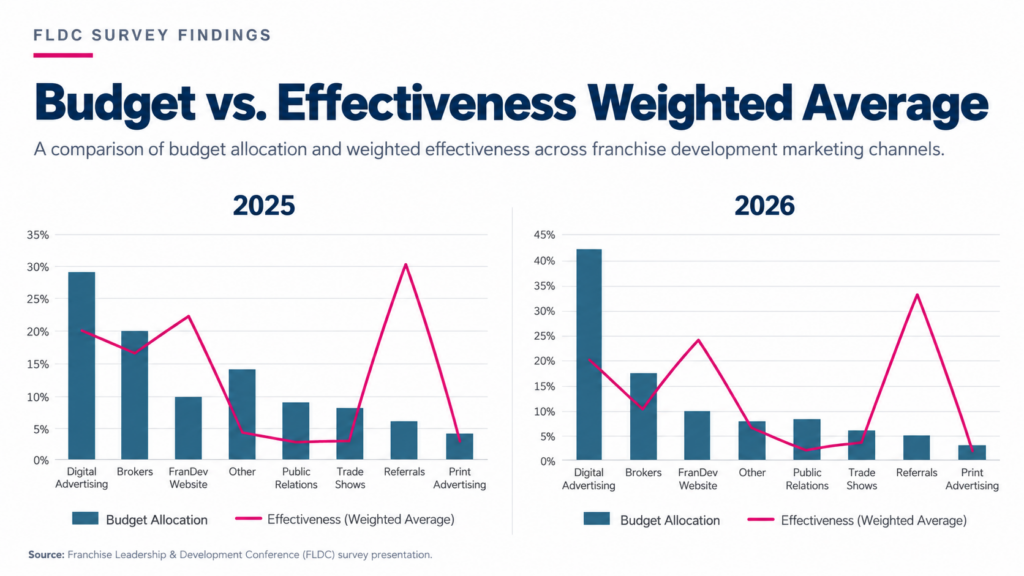
This FLDC survey graphic compares franchise development marketing budget allocation with weighted effectiveness across key channels in 2025 and 2026. It highlights how digital advertising commands the largest share of budget while other channels, including referrals, brokers, and franchise development websites, show varying levels of reported effectiveness. Source: Franchise Leadership & Development Conference (FLDC) survey presentation.
These changes require franchisors to adjust where and how they invest. A larger digital budget doesn’t automatically mean a franchisor is advertising less efficiently. It may reflect a more competitive market, a more selective approach to candidate acquisition, or a broader effort to reach qualified prospects across different platforms. And digital advertising can be highly effective when it’s supported by a strong strategy.
The mistake is assuming that the investment itself is the strategy.
Paid media can buy access to an audience. It cannot guarantee that the audience will find the franchise opportunity compelling.
Think about the prospective franchise candidate’s experience. They see an advertisement for a franchise opportunity. Maybe they’re actively researching investments. Maybe the ad introduces a brand they’ve never considered. Either way, the advertisement has done its initial job: created an opportunity for the brand to be considered.
Now what?
The candidate visits the franchise development website. They want to understand the investment, the business model, the operational requirements, the support structure, and what makes this franchise different from the alternatives they’re considering. They may research leadership, read third-party coverage, watch franchisee interviews, investigate consumer reputation, or search for independent information about the brand. If they’re serious, they’re likely evaluating far more than the advertisement that introduced the opportunity.
And every one of those interactions can either reinforce or weaken their interest. This is where the limitations of a paid-media-first mentality become apparent. Targeting can get you in front of experienced multi-unit operators. Keeping them takes a clear story on operating systems, market opportunity, and franchisee support.
Paid media can amplify the opportunity. It cannot manufacture the underlying reasons someone should choose it.
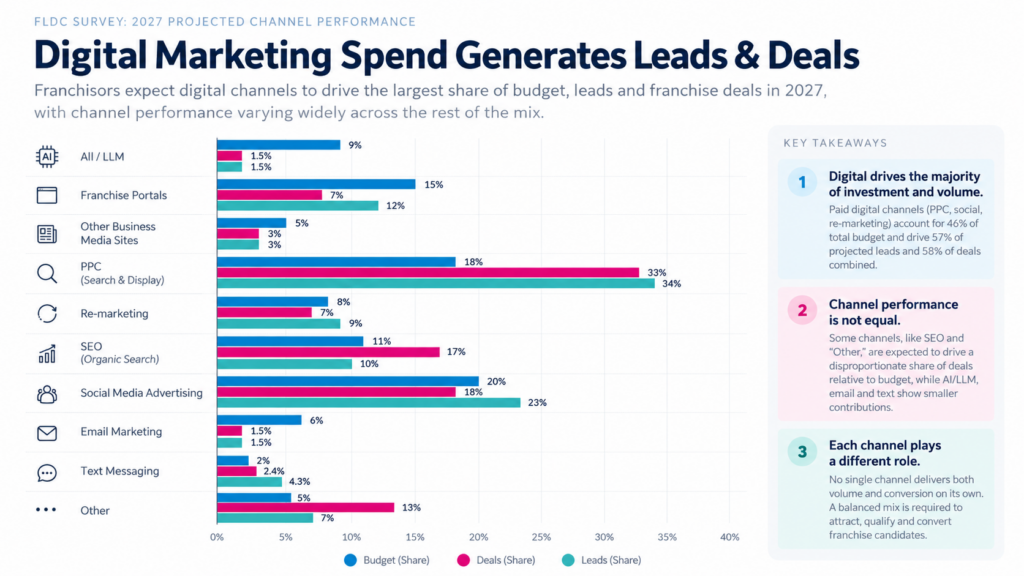
FLDC survey findings compare digital marketing budget allocation with the share of franchise leads and deals attributed to each channel. PPC accounts for 18% of spending, 34% of leads, and 33% of deals, illustrating how channel contributions vary across franchise development. Source: Franchise Leadership & Development Conference (FLDC) survey presentation.
Differentiation is becoming a more expensive problem to ignore
According to the IFA, there are more than 4,000 franchise brands in the United States. That’s a tremendous range of businesses competing for prospective operators, investment capital, and available markets. And while not every franchise competes for the same candidate, there is considerable overlap in how franchise opportunities present themselves.
Look across franchise development websites and advertising and you’ll find familiar claims: Comprehensive training. Ongoing support. A proven business model. An exciting growth opportunity. The chance to be your own boss.
These statements aren’t necessarily inaccurate. The problem is that they do very little to distinguish one franchise from another. If hundreds of brands make essentially the same promises, those promises stop being meaningful differentiators.
Now consider what happens when those brands all invest more heavily in paid media.
More advertisements enter the marketplace. More companies compete for attention. More franchise opportunities are placed in front of prospective candidates. But unless the message gives someone a compelling reason to investigate, greater exposure may simply create more opportunities to be overlooked.
In an environment where people have limited time and numerous alternatives, relevance and clarity matter. A franchise brand needs to explain not simply that an opportunity exists, but why its particular business model deserves serious consideration.
- Who is the ideal operator?
- What makes the operating model different?
- What does support actually look like?
- What expectations should prospective franchisees understand before entering the process?
- Where does the brand have a credible advantage, and what evidence supports it?
These answers shouldn’t be confined to a sales presentation that candidates see weeks after making an inquiry.
They should inform the advertising, website, video, public relations, franchisee storytelling, and development communications from the beginning. That’s how marketing begins qualifying candidates before they ever submit a form.
The 2027 spending projections presented at FLDC deserve context
The FLDC survey findings also offer a useful reminder about the way franchisors interpret industry benchmarks.
According to the figures shared at the conference, respondents anticipated average annual franchise development marketing spending of approximately $297,000 for 2027, with a projected median of $200,000. That’s a $97,000 difference, with the average nearly 49% higher than the median. Neither figure establishes what an individual franchise brand should spend.
Some brands have substantial recognition, an established franchisee network, a mature development process, and opportunities in numerous markets. Others are still establishing their identity, building credibility, and finding the right candidate profile. Their requirements are fundamentally different.
Even if two franchisors have identical annual award goals, the marketing investments necessary to reach those goals may vary considerably. So while these survey findings provide useful context, they shouldn’t become automatic budget recommendations.
And the issue isn’t limited to spending.
Cost-per-lead, cost-per-sale, and conversion-rate benchmarks can also create misleading expectations when applied without accounting for brand maturity, candidate quality, channel mix, and the actual development process.
A franchisor targeting 25 signed agreements cannot simply multiply an industry average cost per sale by 25 and assume those deals will come.
The calculation is easy. Demonstrating the franchise can actually achieve those economics is considerably harder.
Each marketing discipline has a different job
A more effective approach starts by recognizing that franchise development marketing is not a collection of independent channels competing for budget. Each discipline plays a different role in helping a candidate understand, evaluate, and ultimately make a decision about the opportunity.
- Paid media creates targeted exposure and brings prospective candidates into the process.
- The franchise development website serves as a central destination for evaluating the opportunity. It should help people understand the model, determine whether they may be a fit, and identify what they need to learn next.
- Creative and messaging communicate why the franchise is relevant and different. They should establish expectations, not simply generate curiosity. Video gives prospective candidates a more tangible understanding of the business, its people, the operating experience, and the support they can expect.
- Public relations contributes independent visibility and credibility. It can provide context around leadership, growth, franchisee experiences, and the business itself that paid advertising alone cannot provide.
- Franchisee referrals and validation introduce the experiences of people who have already made the investment. And the franchise development team must carry a consistent, accurate story through every interaction.
None of these disciplines should operate in isolation.
A strong PR story can strengthen the credibility of someone arriving through an advertisement. A clear franchisee video can help a candidate evaluate fit before scheduling a call. A development website that explains the investment and operational expectations can reduce inquiries from people who aren’t financially or personally suited to the business.
Consistent messaging between advertising and the development team can prevent confusion that slows decisions or weakens trust.
These aren’t simply branding benefits.
They have practical consequences for candidate quality, the time development teams spend on unqualified inquiries, and the cost of moving a prospective franchisee toward an informed decision.
The objective isn’t to have every channel generate leads. It’s to have every channel contribute to better franchise development outcomes.
The question franchisors should be asking before deciding their budgets
As franchisors establish their 2027 plans, there will be pressure to generate more opportunities and deliver more franchise agreements. For some brands, increasing paid media investment will be appropriate.
But before approving additional spending, leadership should examine what happens after that investment generates interest:
- Are prospective candidates finding a clear, differentiated story about the franchise?
- Can they understand the investment requirements and operating expectations without navigating layers of generic marketing language?
- Does the website help them make a decision, or is it primarily designed to capture their contact information?
- Does the brand have credible franchisee stories and third-party information that reinforce its claims?
- Are marketing and development teams aligned on what constitutes a qualified candidate?
- And can the organization connect marketing investment to qualified conversations, franchise agreements, and actual openings?
These questions reveal whether the rest of the marketing operation is prepared to support the additional attention paid media is expected to generate. If the answers aren’t clear, spending more may not address the real constraint.
The solution may involve strengthening the message, improving the website, developing more useful content, investing in video, earning meaningful media coverage, or addressing friction in the development process. It may also involve improving paid media itself.
The point isn’t to favor one discipline over another. It’s to understand what each contributes and invest accordingly.
Paid media is an amplifier, not the entire strategy
The franchise development industry has access to more advertising platforms, targeting capabilities, and performance data than ever before. That’s an advantage.
But better distribution doesn’t eliminate the need for differentiation, credibility, or a strong candidate experience. If anything, it makes those things more important.
The FLDC survey findings provide an opportunity for franchisors to examine how they’re allocating their 2027 budgets and what they’re expecting those investments to accomplish. That examination should go beyond whether the paid media budget is large enough to deliver the desired number of inquiries.
It should consider whether the broader marketing strategy gives qualified candidates enough reasons to choose the brand once they’ve discovered it. Because franchise development doesn’t end when someone clicks an advertisement or submits a form.
That’s where the real evaluation begins.